
Growth should not come at the expense of control, consistency or resilience
As organisations grow, informal ways of working become increasingly difficult to manage. More people, customers, products and systems create greater operational complexity, while processes and responsibilities that worked when the business was smaller can begin to break down.
E-Squared identifies where this complexity is restricting performance and builds the critical process management systems required to support scalable growth. We work with the people who understand the business to define and implement the processes, controls, responsibilities and management information needed to create a more scalable operational structure.
Our work is delivered through short, focused, hands-on projects designed to produce an implemented result rather than simply recommendations.
From insight to implementation
Implementing Effective Process Management Systems for Scalable Growth
Implementing effective process management systems involves identifying current pain points and mapping out ideal workflows. For example, a logistics company may face challenges in shipment tracking due to fragmented systems. By establishing a comprehensive process management system, real-time tracking can be integrated, significantly enhancing customer satisfaction and operational transparency.
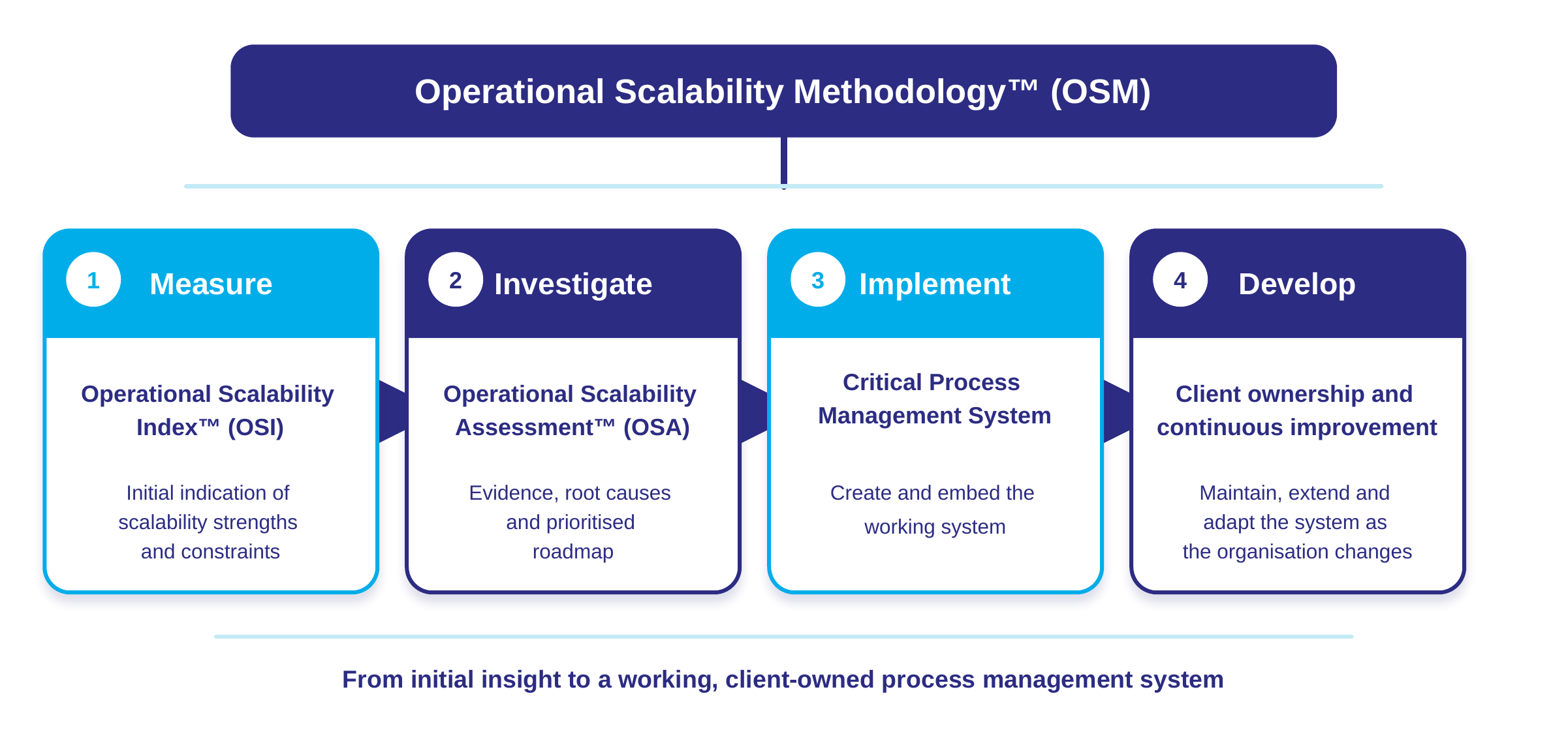
The Operational Scalability Index™ provides an initial indication of the organisation’s scalability strengths and constraints.
Where deeper investigation is required, the Operational Scalability Assessment™ examines the available evidence, identifies root causes and establishes the priorities for action.
E‑Squared then works collaboratively with the people who lead, perform and understand the work to create and implement the required Critical Process Management System. This implementation follows our eight-stage process: beginning with what already exists, refining the critical processes collaboratively and ending with a visible, working system.
Ownership is transferred to the organisation. Its people are equipped to maintain, extend and adapt the system as the business grows and changes. The OSI identifies where a problem may exist. The OSA establishes what is causing it. The implementation creates the working system needed to address it.
The Operational Scalability Methodology™ (OSM) provides a structured route from identifying a scalability problem to implementing the solution.
The Operational Scalability Index™ (OSI) provides an initial indication of an organisation’s scalability strengths and constraints. It considers the factors that determine whether increasing scale can be absorbed without a corresponding loss of performance, visibility or control.
Where deeper investigation is required, the Operational Scalability Assessment™ examines how the organisation actually operates. It identifies the root causes of operational constraints and establishes where improvement will have the greatest impact.
This may reveal poorly defined or inconsistent business processes, unclear responsibilities, dependency on key individuals, gaps in operational knowledge, inadequate management information or weaknesses in operational control.
E-Squared then works with the people who lead, perform and understand the work to create the required Critical Process Management System. This is not simply a process mapping exercise. The objective is to create a working management system in which processes, responsibilities, controls and information operate together.
The resulting system is implemented within the organisation and ownership transferred to its people, enabling them to maintain and develop it as the business changes.
The OSI identifies where a problem may exist.
The Assessment establishes what is causing it.
Implementation creates the working system needed to address it.
What your organisation receives
The precise solution depends on the constraints identified, but the objective remains the same: to create the operational structure required to scale.
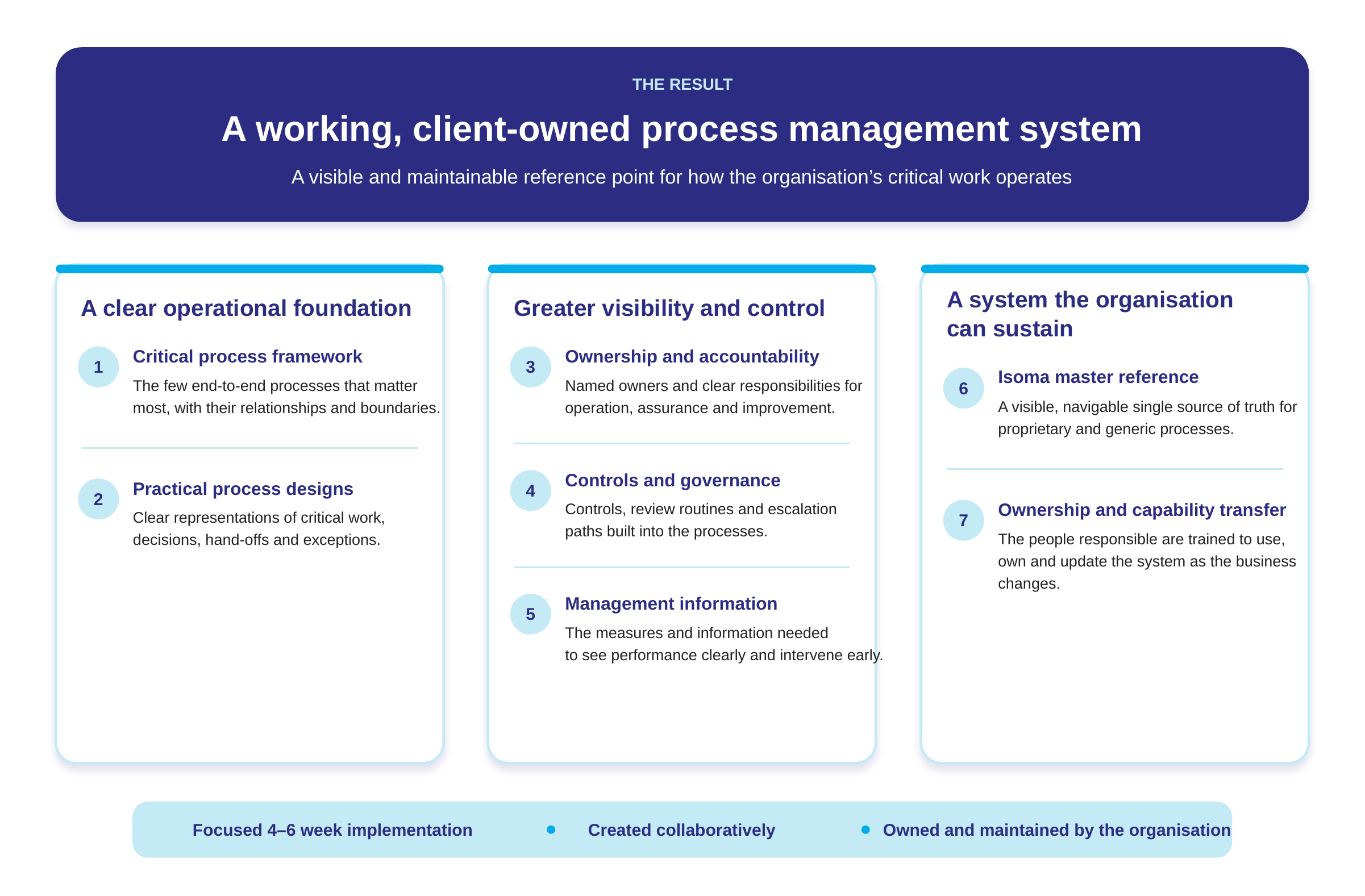
This can include clearly defined end-to-end processes, ownership and accountability, operational controls, management information, documented operational knowledge and mechanisms for monitoring performance.
Rather than treating process improvement, systems, organisational structure and management control as separate activities, they are designed to work together as part of a coherent operational environment.
The result is greater process visibility and a clearer understanding of how work moves across functions, teams and systems. Management can see where responsibility lies, how processes are performing and where intervention is required.
Benefits and Outcomes
Building the operation you need to scale
E-Squared does not simply analyse operational problems or recommend what should change. We identify the constraints limiting scalability and work with your organisation to create and implement the systems required to address them.
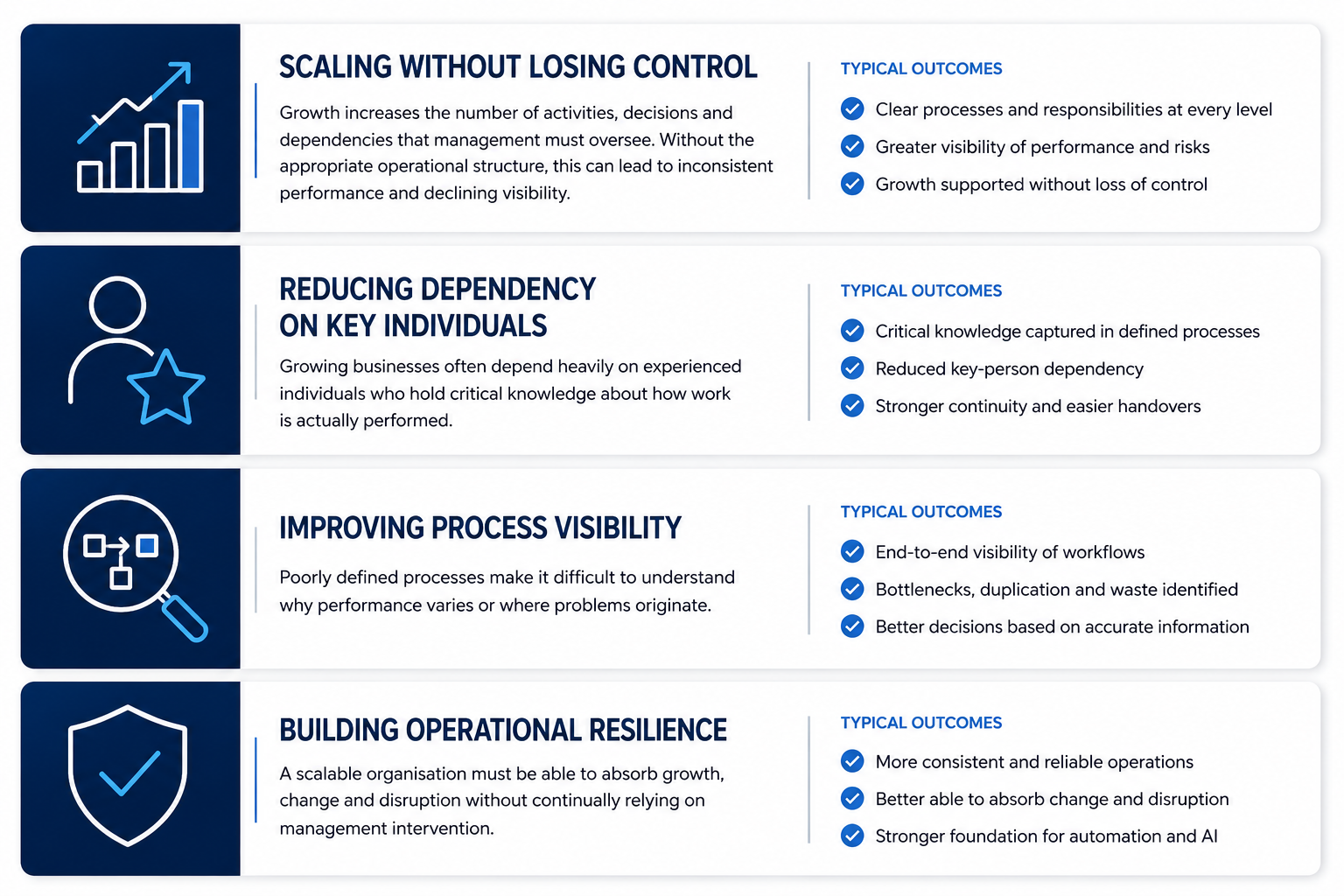
The objective is a business that can grow with greater visibility, consistency and control — supported by an operational structure designed for scale.